
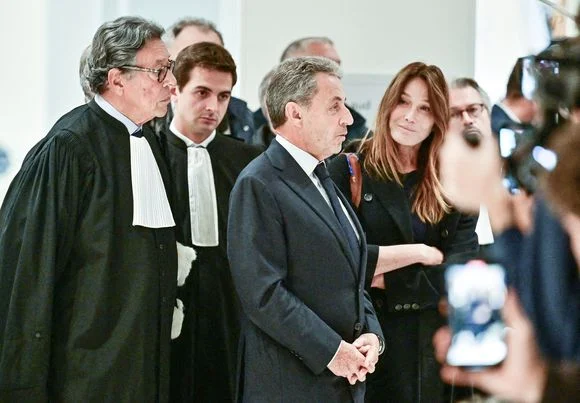
Parfois, la vérité ne surgit pas d’un micro caché ou d’une perquisition spectaculaire, mais d’un objet banal : un smartphone. Et plus précisément d’une application de santé, censée compter les pas et surveiller le rythme cardiaque. Dans l’affaire de la fausse rétractation de Ziad Takieddine, c’est ce détail presque trivial qui a fini par sérieusement embarrasser Carla Bruni.
Une partition judiciaire de plus en plus dissonante
Mise en examen pour association de malfaiteurs en vue de commettre une escroquerie en bande organisée, l’épouse de Nicolas Sarkozy est soupçonnée d’avoir joué un rôle actif dans une opération aux accents de thriller politique : obtenir, à l’automne 2020, la rétractation spectaculaire de Ziad Takieddine, principal accusateur de l’ancien président dans le dossier explosif des financements libyens.
L’opération – surnommée sans pudeur « Sauver Sarko » par ses protagonistes – aurait été orchestrée par la communicante Michèle Marchand, avec, selon les enquêteurs, la participation active de Carla Bruni. Une mise en scène médiatique, puis judiciaire, que l’enquête estime loin d’être spontanée : une promesse de 4 millions d’euros aurait accompagné le changement de version de Takieddine.
Le téléphone qui ne devait pas exister
Au cœur du dossier : une ligne téléphonique « déconnectée du reste ». Le 1er décembre 2019, Carla Bruni écrit à son informaticien pour obtenir un nouveau téléphone, discret, sans lien avec ses usages habituels. Le timing intrigue : la demande intervient quelques heures après une révélation de Mediapart établissant un lien bancaire entre l’entourage de Sarkozy et le régime Kadhafi.
La défense assure d’abord que ce téléphone n’est pas le sien, mais destiné aux enfants. Problème : la ligne est ouverte au nom d’« Alexandre » – un prénom qui ne correspond à aucun membre de la famille – et le numéro figure dans les répertoires de proches de l’ex-président… avec la photo de Carla Bruni associée.
L’écran cassé… et l’alibi fissuré
Nouvelle version : durant les vacances de la Toussaint 2020, son téléphone principal serait tombé lors d’une séance d’elliptigo, rendant l’écran inutilisable. La ligne « secrète » n’aurait servi qu’à pallier cette panne temporaire. Là encore, la mécanique se grippe.
Les juges exploitent une sauvegarde complète du téléphone officiel, saisi en 2023. Résultat : aucune interruption notable d’activité. Messages envoyés, photos prises, connexions au cloud Apple, lecture de la presse, partage de données… le smartphone fonctionne à plein régime pendant toute la période supposée de réparation.
Mais c’est l’analyse de l’application Santé qui achève de convaincre les magistrats. Les données montrent que le téléphone accompagne sa propriétaire très régulièrement, sans rupture d’usage ni immobilisation prolongée. En clair : l’appareil n’était ni cassé, ni rangé dans un tiroir.
Les juges résument sobrement : aucune trace ne permet d’identifier le moment où le téléphone aurait été inutilisable.
Une défense sous tension
Interrogé sur cette ligne, Nicolas Sarkozy affirme n’en avoir découvert l’existence qu’en lisant le dossier. Il la juge même « peu active » pour une supposée association de malfaiteurs. L’avocat de Carla Bruni soutient de son côté que la ligne avait été ouverte bien avant les faits, pour un usage familial, et conteste l’interprétation de l’instruction.
Reste que le Parquet national financier estime les explications de Carla Bruni si changeantes qu’elles semblent, selon ses mots, « construites a posteriori ». Le PNF a requis en décembre 2025 le renvoi devant le tribunal correctionnel de Carla Bruni, de Nicolas Sarkozy et de plusieurs autres protagonistes.
Quand la technologie devient témoin
Ironie mordante de l’époque : ce qui devait rester invisible – un téléphone discret, une ligne cachée – laisse aujourd’hui une traînée numérique implacable. Pas de grandes envolées, pas de preuves spectaculaires : juste des pas comptés, jour après jour, par une application de santé.
Comme quoi, à l’ère du numérique, même les partitions les mieux répétées finissent parfois par sonner faux.
How judges trapped Carla Bruni using her phone’s health app
Sometimes, justice does not rely on wiretaps, dramatic raids, or surprise confessions. Sometimes, it advances quietly — step by step. Literally.
In the investigation into the false retraction of Ziad Takieddine, a key offshoot of the Libyan financing scandal, it was not a hidden microphone that weakened the defence of Carla Bruni, but the data stored on her smartphone. More precisely: her health application.
A judicial score full of wrong notes
Placed under formal investigation for conspiracy to commit fraud against the justice system, Carla Bruni is suspected of having played an active role in an operation aimed at clearing her husband, former French president Nicolas Sarkozy, in the Libyan financing case.
The plan, according to investigators, was simple in principle and audacious in execution: orchestrate in the autumn of 2020 a public and judicial retraction by Ziad Takieddine, Sarkozy’s main accuser. The operation unfolded first in the media — notably on Paris Match and BFMTV — and then before magistrates.
But the retraction was anything but spontaneous. Judicial findings suggest that Takieddine had been promised up to four million euros to align his new version of events with that of the former president. Takieddine has since died, but the trail he left behind continues to haunt the case.
The “ghost phone”
At the heart of the accusations against Carla Bruni lies a discreet device: a second mobile phone, allegedly kept separate from her usual communications.
On 1 December 2019, she wrote to her IT specialist asking for “a new phone with a completely disconnected line.” The timing raised eyebrows. The request came just hours after Mediapart revealed a bank transfer linking Sarkozy’s entourage to the Gaddafi regime for the first time.
Investigators later established that this line served as a communication hub between several protagonists of the false retraction, an operation they themselves reportedly nicknamed “Save Sarko.” In one message, media figure Michèle Marchand even updated Carla Bruni on developments in Lebanon, where Takieddine had taken refuge after fleeing France.
Shifting explanations
Confronted with these elements, Carla Bruni offered several explanations.
First, she claimed the phone was intended for her children. Yet the line was registered under the name “Alexandre” — a name that matches none of them. Worse still, the number appeared in the contact lists of Michèle Marchand and Sarkozy’s chief of staff, complete with Carla Bruni’s photo.
A second explanation followed: during the 2020 autumn holidays, her main phone allegedly fell while she was using an elliptigo bike, cracking the screen and making it difficult to read messages. The secret line, she said, was merely a temporary replacement while the phone was being repaired. No repair invoice was ever produced.
When data contradicts the story
Judges decided to verify this claim the hard way — digitally.
Carla Bruni’s main phone, seized in June 2023, had been fully backed up by a cybercrime specialist working for the courts. The results were unequivocal. During the period when the phone was supposedly unusable, it remained highly active.
Between 16 October and 2 November 2020, the device sent and received messages, took and shared photos, connected to Apple’s cloud services, logged into Wi-Fi networks, forwarded contacts, read the digital edition of Le Figaro, and even shared data with her daughter’s iPhone.
Then came the decisive detail: the health app.
This application, which records physical activity and movements, showed no interruption in use. According to the prosecutors, the phone was worn “very frequently” and accompanied its owner throughout the period in question.
In plain terms: there was no broken phone, no digital blackout, no drawer where the device lay forgotten.
As the judges dryly noted, they were unable to identify “any moment corresponding to the day on which Ms Bruni broke her phone screen and could no longer use it normally.”
A defence under strain
Questioned in November 2024, Nicolas Sarkozy stated that he had learned of the existence of this line only by reading the case file with his lawyers. He added that he found it “not very active for a criminal conspiracy.”
Carla Bruni’s lawyer maintains that the line was opened long before the events under investigation and was used occasionally for private communications unrelated to the case. He also criticises the lack of complete call records from the telecom operator.
Nevertheless, the Parquet national financier considers Carla Bruni’s explanations so inconsistent that they appear to have been “constructed after the fact.” In December 2025, prosecutors requested that she, Nicolas Sarkozy, and several others be sent to trial before a criminal court.
When technology becomes a witness
There is a quiet irony in this case. A device meant to be discreet — even invisible — ended up leaving behind an indelible digital trail. No dramatic confession. No intercepted phone call. Just steps counted, movements logged, habits recorded.
In the digital age, even the most carefully rehearsed stories can be undone by a health app quietly doing its job.