
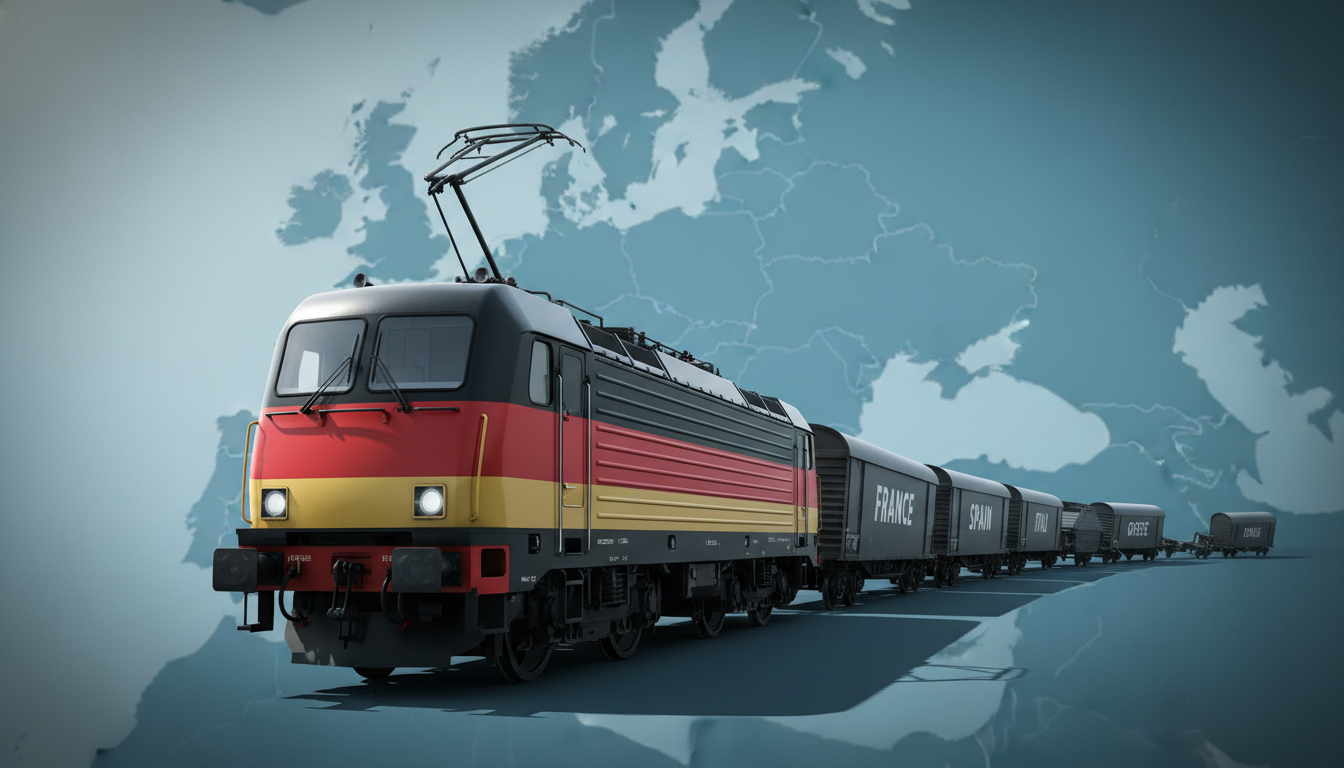
À première vue, l’histoire est simple : l’Allemagne exporte des voitures, des machines et des médicaments, encaisse des excédents colossaux et passe pour l’élève modèle de l’Europe.
On nous répète que c’est « la preuve » qu’il suffit de travailler plus, réformer le marché du travail, serrer les salaires… et prier pour que la magie opère.
En réalité, ce modèle ne fonctionne que parce que les voisins jouent les figurants : désindustrialisation en France, déficit chronique dans le Sud, chômage déplacé chez les autres et déséquilibres financiers qui s’accumulent.
Et, depuis deux ans, le décor commence à se fissurer : choc énergétique, vieillissement, concurrence chinoise et… retour de la guerre commerciale avec les États-Unis.
Ce qui suit n’est pas un éloge du « sérieux allemand », mais l’autopsie d’une stratégie non coopérative au cœur de la zone euro – avec des chiffres à jour.
1. Une machine à excédents toujours monstrueuse
En 2024, l’Allemagne a dégagé un excédent commercial de l’ordre de 240 à 250 Md€ sur les seuls biens : exportations autour de 1,56 billion d’euros, importations d’environ 1,32 billion, soit un surplus proche de 6 % du PIB.AP News+1
Si l’on regarde non plus seulement les biens mais l’ensemble des flux (biens, services, revenus), l’excédent de la balance courante atteint 248,7 Md€ en 2024.Bundesbank
C’est exactement ce que Bruxelles prétend vouloir éviter… mais « oublie » d’appliquer lorsqu’il s’agit de Berlin.
Dans le même temps, la position extérieure nette de l’Allemagne – ce qu’elle détient sur le reste du monde moins ce que le reste du monde détient sur elle – atteint 3 452 Md€ fin 2024, soit plus de 80 % de son PIB.Bundesbank
Dit autrement : l’Allemagne accumule des créances géantes sur la planète, année après année, au lieu de recycler ses excédents en demandant plus de biens et de services étrangers.
En 2025, la machine tourne encore, mais elle tousse :
Sur les neuf premiers mois de 2025, l’excédent courant a reculé à 154,3 Md€, contre 200,2 Md€ un an plus tôt.Trading Economics
La croissance allemande est quasi nulle (0,2 % en 2025 selon les dernières estimations).Wikipédia
On reste donc sur des déséquilibres énormes, mais sur fond de stagnation : ce n’est plus un « miracle », c’est une économie qui vit de ses rentes d’exportation pendant que le moteur interne cale.
2. Qui paie l’addition ? Les voisins européens (et surtout la France)
Contrairement au récit officiel, le gros du commerce allemand ne se fait pas avec la Chine lointaine mais avec le voisinage immédiat.
En 2024, plus de 60 % des échanges de biens se font avec l’Europe, dont plus d’un tiers avec la seule zone euro.bundeswirtschaftsministerium.de
Quelques rappels utiles :
Les États-Unis sont redevenus en 2024 le premier partenaire commercial de l’Allemagne : 252,8 Md€ d’échanges, un excédent allemand d’environ 70 Md€ – grâce à 161 Md€ d’exportations contre 91 Md€ d’importations.AP News
Mais derrière les États-Unis, les principaux clients et débiteurs de l’Allemagne restent ses voisins européens : France, Pays-Bas, Italie, Autriche, Pologne, Royaume-Uni.Trading Economics+1
Pour la France, c’est encore plus brutal :
L’excédent allemand vis-à-vis de la France tourne autour de 50 Md€ par an, soit à peu près la moitié de l’excédent allemand sur l’ensemble de la zone euro.
Autrement dit, une bonne partie des sur-profits de l’industrie allemande se fait sur la désindustrialisation française.
Ce n’est pas seulement un problème de « compétitivité » abstraite :
Les usines, les emplois qualifiés, les centres de décision se déplacent vers l’Est et l’Allemagne ;
La France compense en important des biens industriels et en exportant… des services, du tourisme, et de plus en plus d’armes, ce qui ne bâtit pas exactement un tissu productif équilibré.Le Monde.fr
L’Europe a donc fabriqué une configuration assez absurde : l’usine est en Allemagne, les déficits et la dette sont chez les autres.
3. Le cœur du « modèle » : déflation salariale et sous-investissement intérieur
Rien de tout cela n’est arrivé par magie. C’est le résultat de choix politiques très précis, assumés depuis les réformes Schröder :
Compression du coût du travail (réformes Hartz, mini-jobs, pression sur les salaires).
Modération salariale durable dans l’industrie, alors même que la productivité progressait.
Ouverture massive de filières de sous-traitance à bas coût en Europe centrale et orientale.
Discipline budgétaire et fétichisme du « Schwarze Null » (déficit zéro), au prix d’un sous-investissement massif dans les infrastructures, la transition énergétique et les services publics.
La Commission européenne le dit d’ailleurs… dans son langage technocratique : le surplus courant allemand est le symptôme d’une demande intérieure trop faible par rapport à la production.Economy and Finance
Concrètement :
Les ménages allemands sont moins bien payés que ce que leur productivité permettrait ;
L’État investit moins qu’il ne pourrait ;
Le secteur privé recycle les excédents vers l’étranger au lieu de les transformer en salaires, en hôpitaux, en rails et en rénovation énergétique.
Résultat :
à Berlin, on se félicite des excédents ;
à Athènes, Madrid, Rome ou Paris, on a payé la note sous forme de chômage, d’austérité et de dette publique.
4. 2025 : quand la guerre commerciale et la Chine rattrapent le modèle
La nouveauté des deux dernières années, c’est que le modèle exportateur allemand se retrouve pris entre deux feux :
Les États-Unis de Trump, saison 2
Depuis 2024, les exportations allemandes vers les États-Unis ont atteint un record historique (plus de 10 % des exportations totales), notamment dans l’auto et la pharma.Wall Street Journal
En réponse, Washington a dégainé un tarif général de 10 % sur toutes les importations et une surtaxe de 25 % sur les automobiles, l’acier et l’aluminium, qui frappent directement le cœur de l’industrie allemande.Wall Street Journal+1
Les constructeurs allemands commencent déjà à provisionner des pertes. Volkswagen a annoncé ses plus faibles profits depuis 2021 en partie à cause de ces mesures.Wall Street Journal
La Chine qui monte en gamme… et arrose l’Europe de voitures électriques et de machines
L’Allemagne reste excédentaire globalement, mais devient déficitaire avec la Chine : importations d’équipements électroniques, batteries, composants automobiles, etc., tandis que les exportations allemandes reculent.Reuters+1
En 2025, Pékin a même repris le rang de premier partenaire commercial de l’Allemagne, aidé par la baisse des échanges avec les États-Unis sous l’effet des droits de douane.Reuters
Ajoutez à cela :
la fin du gaz russe bon marché, remplacé par un mix plus cher LNG + renouvelables ;
un vieillissement démographique accéléré ;
un appareil productif très centré sur la voiture thermique, alors que la bascule vers l’électrique et le logiciel favorise… les concurrents.
On commence à découvrir que vivre en exportant son chômage aux voisins marche beaucoup moins bien quand ceux-ci sont en stagnation… et quand les États-Unis et la Chine décident de jouer à armes inégales.
5. Ce que disent vraiment les règles européennes (quand on veut bien les lire)*
Officiellement, l’Union européenne a mis en place un outil pour surveiller les déséquilibres : la procédure pour déséquilibres macroéconomiques (MIP, pour les amateurs de sigles).
Au menu : un tableau de bord avec des seuils « d’alerte », dont un plafond de +6 % du PIB pour les excédents courants, contre un plancher de –4 % pour les déficits.Economy and Finance+1
Or :
L’excédent courant allemand a été au-dessus de 6 % du PIB entre 2011 et 2021, avant de retomber à 4,2 % en 2022 puis de remonter à 5,9 % en 2023.Economy and Finance
La moyenne 2022-2024 reste autour de 5,3 % – à la limite du seuil, mais toujours très élevée pour un pays de cette taille.euagenda.eu+1
Normalement, ça devrait déclencher des « recommandations » fermes, voire des sanctions. En pratique : rien, ou presque.
Quand la Grèce ou le Portugal dépassent 3 % de déficit, c’est l’Apocalypse. Quand l’Allemagne dépasse 6 % d’excédent pendant une décennie, c’est « la preuve de sa vertu ».
Le problème, ce n’est pas seulement l’hypocrisie :
Un déficit et un excédent sont les deux faces du même déséquilibre.
Chaque euro d’excédent allemand correspond à un euro de déficit ailleurs dans la zone euro.
On ne peut pas avoir 27 pays « excédentaires entre eux ». C’est de l’arithmétique, pas de l’idéologie.
Keynes l’avait déjà compris en 1944 avec son projet de monnaie internationale, le Bancor :
Les pays excédentaires doivent être poussés à revaloriser les salaires, investir, importer davantage, au même titre que les pays déficitaires doivent ajuster leur position.
Tant que l’Europe se refuse à traiter l’excédent allemand comme un problème collectif, elle organise sa propre instabilité.
6. L’Allemagne exporte aussi… son chômage et sa fragilité future
Que produit concrètement cette stratégie d’obsession excédentaire ?
Pour les autres pays européens
Des déficits extérieurs persistants, financés par de la dette ou des ventes d’actifs ;
Des politiques d’austérité pour « regagner de la compétitivité », autrement dit : baisser les salaires et comprimer la demande intérieure ;
Une désindustrialisation accélérée dans les pays du Sud et en France, qui se sont retrouvés enfermés dans un rôle de marchés de débouchés pour les biens allemands.
Pour l’Allemagne elle-même
Une infrastructure vieillissante, des investissements publics reportés ;
Une forte dépendance à quelques secteurs phares (automobile, machines, chimie) aujourd’hui bousculés par la transition énergétique et la concurrence chinoise ;
Un niveau de richesse extérieure (3 452 Md€ d’actifs nets) qui ressemble à un gigantesque portefeuille de créances… dont la valeur dépend de la capacité des pays débiteurs à payer.Bundesbank+1
C’est un peu comme si l’Allemagne avait passé vingt ans à serrer la ceinture de ses salariés pour gaver un fonds souverain implicite, sans jamais décider ce qu’elle voulait vraiment faire de cet argent.
7. Que faire ? Ralentir Usain Bolt, pas casser les jambes des autres coureurs
La question clé n’est pas : « Comment la France peut-elle devenir l’Allemagne ? »
Cette course-là est truquée. Plus Paris essaiera de copier Berlin, plus l’Allemagne répliquera en poussant encore plus loin la déflation salariale, et ainsi de suite.
On ne rattrape pas Usain Bolt en lui criant « cours moins vite » depuis le couloir d’à côté.
Il faudrait au contraire changer les règles de la course :
En Allemagne
Revaloriser nettement les salaires bas et moyens, surtout dans l’industrie exportatrice ;
Lancer un programme massif d’investissement public : infrastructures, rail, logement, énergie, numérisation ;
Accepter un excédent courant plus faible en échange d’un niveau de vie plus élevé et d’une économie moins dépendante de la demande étrangère.
Au niveau européen
Rendre la procédure pour déséquilibres macroéconomiques réellement symétrique : excédents comme déficits doivent être corrigés ;
Mettre en place un budget européen d’investissement capable de recycler une partie des excédents allemands via des programmes communs (transition énergétique, recherche, défense, etc.) ;
Redonner aux pays les moyens de reconstruire une base industrielle sans être étranglés par des dogmes budgétaires qui n’ont jamais été appliqués à la lettre par Berlin.
En France
Arrêter de courir après le « coût du travail » et regarder enfin le coût du capital, de l’énergie, des infrastructures défaillantes ;
Réorienter les aides publiques vers la montée en gamme industrielle, la formation et les filières stratégiques plutôt que vers les dividendes ;
Assumer un discours clair à Bruxelles : l’euro ne survivra pas si le cœur allemand continue de pomper le sang de la périphérie.
Conclusion : la fin du modèle ou la fin de l’Europe telle qu’on la connaît
En 2025, l’Allemagne reste une puissance industrielle majeure et un champion de l’export.
Mais son modèle montre de sérieuses fissures : choc énergétique durable, vieillissement, tarissement partiel du débouché américain, offensive chinoise et stagnation intérieure.
Pour l’instant, personne ne veut poser la question qui fâche :
L’Allemagne peut-elle continuer à accumuler des excédents colossaux pendant que ses voisins s’endettent et se désindustrialisent ?
Ou faudra-t-il, tôt ou tard, reconnaître que le « modèle allemand » est moins un exemple à suivre qu’une anomalie structurelle qui fait dérailler l’Europe ?
Si rien ne change, deux scénarios se dessinent :
soit les excédents allemands se contractent brutalement sous l’effet d’une crise externe (nouvelle guerre commerciale, choc financier, rupture énergétique) ;
soit les déséquilibres internes à la zone euro continuent de s’aggraver, jusqu’à ce que l’un des maillons casse.
Dans les deux cas, la France n’a pas intérêt à rester spectatrice.
Elle a tout à gagner à remettre sur la table le débat interdit : non, la vertu économique ne se mesure pas à la taille des excédents, mais à la capacité d’un continent à produire, investir et vivre correctement… sans que certains pays prospèrent au détriment des autres.
Why the “German Model” Is Derailing Europe
(and why the machine may finally be slowing down)
Introduction: A “model” that looks increasingly like an anomaly
At first glance, the story seems simple: Germany exports cars, machines and pharmaceuticals, racks up gigantic trade surpluses, and is hailed as the European straight-A student.
We’re told this is “proof” that all it takes is labour-market reforms, wage moderation, a dash of discipline—et voilà, prosperity.
In reality, this model works only because the neighbours quietly play the supporting cast: France deindustrialises, Southern Europe piles up deficits, unemployment is offshored, and financial imbalances deepen.
And in the last two years, cracks have begun to appear in the shiny façade: an energy shock, demographic ageing, intensifying Chinese competition, and the return of a trade war with the United States.
What follows is not another love letter to German “seriousness”, but an autopsy of a non-cooperative strategy at the heart of the eurozone—supported with updated and verifiable data.
1. A surplus machine still running… but coughing
In 2024, Germany generated a trade surplus of roughly €240–250 billion in goods alone—exports around €1.56 trillion, imports about €1.32 trillion, representing nearly 6 % of GDP.
If we look beyond goods to the current account—goods, services and investment income combined—the surplus hit €248.7 billion in 2024.
This is precisely the sort of imbalance Brussels claims to monitor… except when the imbalance comes from Berlin.
Meanwhile, Germany’s net international investment position (NIIP) reached €3.45 trillion at the end of 2024—more than 80 % of GDP.
In plain English: Germany accumulates colossal IOUs from the rest of the world year after year, instead of recycling its surpluses into higher wages or domestic investment.
In 2025 the machine is still running, but not smoothly:
- In the first nine months of 2025, Germany’s current account surplus fell to €154 billion, down from €200 billion the previous year.
- Growth is essentially flat—0.2 % in 2025.
The imbalances remain enormous, but the engine is sputtering. It’s no longer an “economic miracle”—it’s a giant export machine feeding an anaemic domestic economy.
2. Who pays the price? Europe—and especially France
Forget the myth about Germany’s trade being “global”: over 60 % of German trade takes place with Europe, and more than one-third with the eurozone itself.
Some key reminders:
- The United States is Germany’s largest trading partner, with €253 billion in bilateral goods trade in 2024 and a German surplus of around €70 billion.
- But behind the U.S., Germany’s biggest clients—and biggest deficit-makers—are its neighbours: France, the Netherlands, Italy, Austria, Poland, the U.K.
For France, the picture borders on tragicomedy:
- Germany runs a €50 billion surplus every year against France—half of its total surplus within the eurozone.
- In other words, a huge share of Germany’s industrial profits comes directly from French deindustrialisation.
This isn’t theory, it’s the geography of production:
- factories, skilled jobs and R&D centres migrating eastwards and northwards;
- France increasingly exporting services, tourism… and weapons—hardly the backbone of a balanced industrial ecosystem.
Europe has manufactured an absurd configuration: Germany is the factory; the others are the debtors and consumers of last resort.
3. The core of the model: wage suppression and underinvestment
Nothing in this system happened by accident. It is the result of deliberate choices dating back to the Schröder era:
- Wage restraint and labour-market reforms (Hartz), creating millions of underpaid “mini-jobs”;
- Persistent salary moderation in export industries despite rising productivity;
- Extensive supply-chain outsourcing to low-wage Central and Eastern Europe;
- The fetish of the “Schwarze Null”—balanced budgets—at the cost of chronic underinvestment in infrastructure, energy, transport, digitalisation and public services.
The European Commission itself admits—in its technocratic dialect—that Germany’s surplus is the result of domestic demand being structurally too weak relative to production capacity.
Translated:
- German workers are paid less than their productivity would justify;
- The state invests less than it should;
- Corporations stash cash abroad instead of powering domestic consumption and investment.
Germany congratulates itself.
Its neighbours foot the bill: unemployment, austerity and a broken industrial base.
4. 2025: Caught between Trump and China
What’s new is that the German model is now being hit from both sides:
1. The United States under Trump (again)
In 2024, German exports to the U.S. hit a record—over 10 % of total exports—especially in autos and pharmaceuticals.
Washington’s response?
- A universal 10 % import tariff,
- Plus a 25 % surtax on cars, steel and aluminium—directly targeting German industry.
German carmakers are already taking hits. Volkswagen recently reported its weakest profits since 2021, partly due to these trade measures.
2. China’s move up the value chain
- Germany now runs a large trade deficit with China, importing electronics, batteries and EV components while its own exports to China stagnate.
- In 2025, China even regained its spot as Germany’s top trading partner as U.S. volumes shrank under tariff pressure.
Add in:
- The end of ultra-cheap Russian gas;
- A rapidly ageing population;
- An industrial base heavily tied to combustion engines and hardware manufacturing, just as the global economy shifts to software, EV platforms and AI.
The era where Germany could export unemployment to its neighbours while relying on the U.S. and China for demand is coming to an end.
5. The uncomfortable truth about EU rules
Brussels has a monitoring tool for macroeconomic imbalances—the MIP scoreboard—which sets:
- a 6 % of GDP ceiling for surpluses,
- a –4 % floor for deficits.
Germany has exceeded the ceiling for an entire decade.
What happened?
Absolutely nothing.
When Greece or Portugal breach the deficit threshold, it’s front-page news.
When Germany breaches the surplus ceiling for ten straight years, it’s “proof of virtue”.
The problem isn’t moral hypocrisy; it’s arithmetic:
Every euro of German surplus equals a euro of deficit elsewhere in the eurozone.
Twenty-seven countries cannot all be net exporters to one another.
Keynes understood this in 1944 with his plan for a global clearing union:
- Surplus countries must adjust just as deficit countries do.
- Otherwise the system destabilises itself.
Europe has forgotten this basic truth.
6. Germany also exports its unemployment—and its future fragility
The obsession with surpluses has two major effects:
For partner countries
- Persistent external deficits, financed by debt and asset sales;
- Austerity policies to regain “competitiveness”, meaning wage cuts and demand contraction;
- Accelerated deindustrialisation, especially in France and Southern Europe.
For Germany itself
- Ageing infrastructure, chronic underinvestment;
- Overreliance on a few industrial champions (auto, chemicals, machinery) now threatened by the EV transition and Asian competition;
- A gigantic €3.45 trillion net external asset position—a mountain of paper wealth whose value depends on the ability of debtor countries to repay.
It is as if Germany spent 20 years tightening workers’ belts to fatten an implicit sovereign wealth fund—without ever deciding what it was for.
7. What should be done? Slow down Usain Bolt, don’t break everyone else’s legs
The question is not:
“How can France become Germany?”
That race is unwinnable. The closer France gets, the more Germany will tighten its labour costs to stay ahead.
Instead, Europe needs to change the rules of the race.
In Germany
- Substantial wage increases, especially in export industries;
- A massive public investment programme—infrastructure, energy, housing, transport, digitalisation;
- A strategic acceptance of lower trade surpluses in exchange for higher living standards.
At the European level
- Make the macro-imbalance rules symmetrical: surpluses must be corrected as seriously as deficits;
- Create a European investment budget to recycle part of German surpluses into continent-wide strategic programmes;
- Allow countries to rebuild industrial capacities without being strangled by arbitrary deficit limits.
In France
- Stop obsessing over labour costs and look at the cost of capital, energy, logistics and underinvestment;
- Redirect public aid toward advanced manufacturing, training and strategic sectors instead of dividends;
- State clearly in Brussels: the euro cannot survive if one country accumulates surpluses and the others accumulate debt.
Conclusion: The end of the model—or the end of Europe as we know it
In 2025, Germany remains a major industrial power and export champion.
But the foundations of its model are weakening: an energy shock, Chinese competition, demographic decline, a fragile U.S. relationship, and domestic stagnation.
No one dares ask the real question:
- Can Germany keep running gigantic surpluses while its neighbours drown in deficits?
- Or is the “German model” less a success story than a structural imbalance destabilising the entire continent?
If nothing changes, only two scenarios are plausible:
- German surpluses shrink abruptly under an external shock (trade war, financial crisis, energy rupture).
- Eurozone imbalances worsen until one of the links breaks.
Either way, France cannot afford to remain a spectator.
A healthy Europe is not one where a single country accumulates surpluses while the rest accumulate debt—but one where production, investment and prosperity are shared rather than extracted.
Sources·59
-

AP News
US displaced China as Germany's biggest single trading partner last year
19 février 2025 — In 2024, the United States became Germany's largest single trading partner for the first time since 2015, overtaking China. According to Germany's Federal Statistical Office, trade between Germany and the U.S. rose slightly by 0.1% to approximately €252.8 billion, while trade with China fell by 3.1% to €246.3 billion. The Netherlands ranked third in Germany’s trade relationships with €205.7 billion, also reflecting a decline. Germany, Europe’s largest economy, has faced stagnant economic growth over the past five years and experienced contraction in the past two. The country continues to struggle with rising competition from Chinese firms and other global economic challenges. Germany’s trade surplus with the U.S. increased to €70 billion, driven by a rise in German exports to €161.4 billion and a decline in American imports to €91.4 billion. Conversely, Germany’s trade deficit with China widened, with exports to China falling 7.6% and imports marginally declining. Overall, Germany’s total exports dropped 1.2% to €1.56 trillion in 2024, while total imports decreased 3% to €1.32 trillion. Addressing the country’s economic stagnation and navigating international trade dynamics will be crucial for the incoming German government.
-
Bundesbank
German balance of payments in December 2024
-
Bundesbank
Germany’s international investment position at the end of 2024 | Deutsche Bundesbank
-
Trading Economics
Germany Current Account
Over the first nine months of 2025, Germany's current account surplus narrowed to EUR 154.3 billion, compared with EUR 200.2 billion in the same period of 2024.See more
-
Wikipédia
Economy of Germany
-
bundeswirtschaftsministerium.de
Facts about German foreign trade
Germany's share of trade with the eurozone in 2023 amounted to 38.3 % for German exports (2008: 43.2 %) and 35.0 % for imports (2008: 39.4 %). ○ The importance ...
-
Trading Economics
Germany Exports By Country
Germany's main export partners were: the United States, France and the Netherlands. ... In 2024, Germany had a trade surplus of US$253.80 Billion. Germany ...
-
Le Monde.fr
France consolidates its position as the world's second-largest arms exporter
9 mars 2025 — Between 2020 and 2024, Ukraine became the world's largest arms importer due to the ongoing conflict with Russia, with imports increasing nearly 100-fold. According to a report by the Stockholm International Peace Research Institute (SIPRI), France has solidified its position as the second-largest arms exporter globally, with 9.6% of the market, surpassing Russia (7.8%) but trailing far behind the U.S. (43%). European arms imports rose 155% over the past five years, emphasizing the continent's rearmament amid instability and doubts about NATO reliability, particularly under U.S. political uncertainty. U.S. companies dominate the arms market, with major players such as Lockheed Martin and Boeing leading global sales, especially in fighter jets and missile systems. Europe's defense industry remains strong in areas like tanks and armored vehicles, with support from countries like Italy, France, and Germany. Meanwhile, Russian exports have sharply declined (-64%) due to wartime needs and economic sanctions. France’s rise is attributed to arms deals with Ukraine and Rafale fighter jet exports, particularly to India. New arms exporters like South Korea and Turkey are also emerging as challengers on the global stage.
-
Economy and Finance
In-Depth Review 2024 Germany - Economy and Finance
11 juin 2024 — 18 Apr 2024 — The surplus exceeded 6% of GDP between 2011 and 2021, but dropped to 4.2% in 2022 before widening again to 5.9% of GDP in 2023. The three-year ...
-
Wall Street Journal
German Exports to U.S. Reached Highest Proportion in Two Decades in 2024
14 avril 2025 — In 2024, German exports to the U.S. accounted for 10.4% of the country's total exports, reaching a two-decade high of €161.3 billion ($183.3 billion), according to Germany's statistics agency, Destatis. The U.S. became Germany's largest trading partner, overtaking China, whose slowing economy weakened trade with Germany. However, these gains may be short-lived due to new U.S. tariffs under President Trump’s administration. As of April 2025, a 10% general tariff and a 25% levy on automobiles, steel, and aluminum have been introduced, impacting Germany’s manufacturing-heavy economy. Pharmaceutical exports, valued at €27 billion, and car exports, valued at €34 billion, are particularly vulnerable. Pharmaceutical tariffs are expected soon, while the auto sector already faces losses—Volkswagen projected its weakest profit since 2021 partly due to tariff-related write-downs. In response, Germany is increasing infrastructure and defense spending, reversing previous fiscal discipline.
-
Reuters
China overtakes US as Germany's top trading partner
22 octobre 2025 — 22 Oct 2025 — US tariffs cut German exports 7.4% in the first 8 months of 2025 · German exports to China fall 13.5%, imports rise 8.3% · Concerns over Chinese ...
-
Economy and Finance
Scoreboard - Economy and Finance - European Commission
Scoreboard indicators · current account balance as percent of GDP (3-year backward moving average), with thresholds of +6% and -4%. · net international investment ...
-
euagenda.eu
2025 In-Depth Review Germany
The three-year average for 2022-2024 stands at 5.3% of GDP, which is below the indicative MIP scoreboard threshold of 6% of GDP. The decline was primarily ...
-
destatis.de
Exports in December 2024: +2.9% on November 2024
-
destatis.de
In 2024, United States became Germany's most important ...
19 Feb 2025 — Goods to the value of 156.3 billion euros imported from China · Motor vehicles, trailers and semi-trailers most important export and import goods ...
-
destatis.de
Exports in November 2024: +2.1% on October 2024
9 Jan 2025 — In November 2024, German exports were up by 2.1% while imports were down by 3.3% on a calendar and seasonally adjusted basis compared with October 2024.
-
destatis.de
Exports in August 2024: +1.3% on July 2024
9 Oct 2024 — The unadjusted foreign trade balance showed a surplus of 18.9 billion euros in August 2024. In August 2023, the surplus was 16.9 billion euros.
-
destatis.de
Foreign trade - German Federal Statistical Office
Accounting for 17.0% of exports, motor vehicles and parts thereof were Germany's main export product in 2024. Machinery (14.2%) and chemical products (9.0%) ...
-
destatis.de
Advanced search - German Federal Statistical Office
The foreign trade balance showed a surplus of 16.8 billion euros in July 2024. ... Germany's foreign trade balance (exports minus imports) amounted to +138.8 ...
-
ceps.eu
The Macroeconomic Imbalance Procedure and Germany:
13 Nov 2013 — The threshold for current account surpluses (6% of GDP) is at any rate entirely arbitrary. Moreover, one should not look at the surplus ...
-
europa.eu
Euro area international trade in goods surplus €1.0 bn
16 Oct 2025 — The EU balance showed a €5.8 bn deficit in trade in goods with the rest of the world in August 2025, compared with -€2.4 bn in August 2024.
-
europa.eu
Euro area international trade in goods surplus €4.6 bn
17 Oct 2024 — The first estimates of euro area balance showed a €4.6 bn surplus in trade in goods with the rest of the world in August 2024, compared with €4.8 bn in August ...
-
europa.eu
Extra-euro area trade in goods - Statistics Explained - Eurostat
In 2024, the euro area recorded a trade surplus of €173 billion. Euro area trade with countries outside the Euro area increased between 2014 and 2024 with ...
-
europa.eu
Euro area international trade in goods surplus €19.4 bn
14 Nov 2025 — The EU balance showed a €16.3 bn surplus in trade in goods with the rest of the world in September 2025, compared with +€9.5 bn in September ...
-
europa.eu
Euro area international trade in goods surplus €12.4 bn
15 Sept 2025 — The EU balance showed a €12.1 bn surplus in trade in goods with the rest of the world in July 2025, compared with +€15.9 bn in July 2024. The ...
-
europa.eu
International trade in goods - Statistics Explained - Eurostat
In 2024, the EU trade in goods balance registered a surplus of €147 billion. This marks a great contrast to 2022 when the EU reported a deficit of €436 ...
-
europa.eu
[tet00003] Exports of goods and services in % of GDP
Exports of goods and services in % of GDP. The value of exports of goods and services, as a percentage of the gross domestic product (GDP). Also available ...
-
europa.eu
Extra-euro area trade in goods Statistics Explained
28 Apr 2025 — Germany accounted for 33.7% of exports, followed by Italy (12.7%), the Netherlands (12.3%) and France (11.0%). Figure 7: Extra-euro area exports ...
-
econstor.eu
The Macroeconomic Imbalance Procedure at the Heart of ...
by W Koll · 2022 · Cited by 13 — The selection of indicators in the scoreboard and the threshold values chosen – e.g. a -4% of GDP floor for current account deficits but a +6% ceiling for ...
-
tradingeconomics.com
Germany - Exports of goods and services in % of GDP
-
tradingeconomics.com
Government deficit/surplus, debt and associated data
Euro Area - Government deficit/surplus, debt and associated data was -3.10 % of GDP in December of 2024, according to the EUROSTAT.
-
sciences-po.fr
Should Germany's surpluses be punished?
3 Mar 2015 — An alert is issued when an indicator exceeds a certain threshold, e.g. 60% of GDP for public debt, 10% for the unemployment rate, -4% (+6% ...
-
bundesbank.de
Germany's international investment position at the end of ...
30 Sept 2025 — Overall, Germany's net external assets at the end of 2024 were €555 billion higher than at the end of 2023.See more
-
bundesbank.de
Balance of payments
Current data and changes compared with the previous month ... Germany's current account recorded a surplus of €18.6 billion in September 2025, up €9.1 billion on ...See more
-
bundesbank.de
German balance of payments in September 2024
Rise in current account surplus. Germany's current account recorded a surplus of €22.6 billion in September 2024, up €5.5 billion on the previous month's level.See more
-
bundesbank.de
German balance of payments in January 2024
Current account surplus down. Germany's current account recorded a surplus of €29.7 billion in January 2024, down €1.9 billion on the previous month's level.See more
-
bundesbank.de
Annual accounts for 2024
25 Feb 2025 — The Bundesbank posted losses of around €19.8 billion in 2024, after a loss of €21.6 billion in the previous year.See more
-
boeckler.de
1 Reform of the Macroeconomic Imbalance Procedure
30 Oct 2021 — The scoreboard in its latest vintage has 14 main quantitative indicators with thresholds, supplemented by no less than 28 auxiliary indicators.
-
oup.com
What drives the German current account? And how does it ...
by R Kollmann · 2015 · Cited by 138 — The first step is a screening for potential imbalances against a scoreboard of 11 indicators, comprising the current account balance, the net international ...
-
eurofi.net
SEPTEMBER 2025
... current account surpluses in Germany and the Netherlands (over 8% of. GDP on average over the% period) reflect a situation of “fundamental imbalance” in IMF ...
-
worldbank.org
Exports of goods and services (% of GDP) - Germany
Exports of goods and services (% of GDP) - Germany. Country official statistics, National Statistical Organizations and/or Central Banks; National Accounts ...
-
worldbank.org
Exports of goods and services (% of GDP)
Germany. 2024. 42.1. Ghana. 2024. 35.3. Gibraltar · Greece. 2024. 42.0 ... 2024. 181.7. Hungary. 2024. 74.7. Iceland. 2024. 41.6. India. 2024. 21.2. Indonesia.
-
ethz.ch
The Macroeconomic Imbalance Procedure and Germany
13 Nov 2013 — The threshold for current account surpluses (6. % of GDP) is at any rate entirely arbitrary. Moreover, one should not look at the surplus ...
-
santandertrade.com
German foreign trade in figures - Santandertrade.com
According to preliminary figures from Destatis, in the period Jan-Nov 2024, Germany exported EUR 1,427.8 billion worth of goods, against EUR 1,108 billion in ...
-
oec.world
Germany (DEU) Exports, Imports, and Trade Partners
6 Nov 2025 — The most common destinations of the exports of Germany are United States ($165B), France ($121B), Netherlands ($110B), China ($104B), and Italy ...
-
wikipedia.org
List of the largest trading partners of Germany
In 2024, the United States became Germany's largest trading partner again after 9 years, followed by China and the Netherlands. Exports by country ...
-
briskmarkets.com
Strong German trade surplus of €22.5 billion in August 2024
9 Oct 2024 — German Trade in August 2024, Germany posted a strong trade surplus of €22.5 billion, supported by higher exports and lower imports.
-
ceicdata.com
Germany Current Account Balance: % of GDP, 1991
Germany Current Account surplus accounted for 3.9 % of the country's Nominal GDP in Dec 2024, compared with a 5.2 % surplus in the previous quarter.
-
europe-data.com
Euro area trade surplus narrowed in August 2025
17 Oct 2025 — Looking at the European Union as a whole, the trade balance reported a deficit of €5.8 billion in August 2025, compared with a deficit of €2.4 ...
-
europe-data.com
The United States is now Germany's most important trading ...
21 Feb 2025 — Overall, Germany's foreign trade balance for 2024 showed a surplus of €239.1 billion, up from €217.7 billion in 2023. Read more here. Like this:.
-
vizionapi.com
Ocean Booking Data Reveals Structural Shifts Amid ...
4 days ago — Germany's official trade statistics show a substantial trade surplus (€239.1 billion in 2024) based on monetary value, while VIZION's container ...
-
osw.waw.pl
German exports under pressure: Germany's trade in 2024
4 Mar 2025 — In 2024, the United States was Germany's most important trading partner, with a trade volume of €253.4 billion and a surplus of €70 billion.
-
fastbull.com
German Exports Surge in January 2024, Rising by 6.3% ...
In January 2024, Germany experienced a robust economic performance, marked by a 6.3% surge in exports and a 3.6% increase in imports compared to December ...
-
bnpparibas.com
EUROPEAN UNION: FROM TRADE DEFICIT TO SURPLUS
26 Apr 2024 — After two years of deficit, the EU trade balance returned to positive territory in. 2023, supported in particular by falling energy prices.
-
dbresearch.com
Focus Germany
17 Jul 2025 — Since 2015, German export competitiveness has been on a downward trend and net exports have not contributed positively to real GDP growth.
-
alchempro.com
German exports down 1% YoY in 2024, imports decline 2.8 ...
10 Feb 2025 — Exports were down by 1 per cent YoY in 2024, while imports saw a decline of 2.8 per cent YoY. The country exported goods worth €131.7 billion ...
-
bis.org
Presentation of the Deutsche Bundesbank's Annual Report ...
25 Feb 2025 — the Bundesbank managed to record a balanced result in financial year 2023. Distributable profit came to zero. Page 10. But that left just ...See more
-
df-alliance.com
What are Germany's Main Exports and Imports?
26 Sept 2025 — In 2024, Germany generated goods exports exceeding $1.6 trillion USD, while imports inched in at $1.4 trillion USD, a persistent positive trade ...
-
aljazeera.com
China overtakes the US as Germany's largest trading partner
22 Oct 2025 — The US was Germany's top trading partner in 2024, ending an eight-year streak for China. Germany had sought to reduce its reliance on China, ...